
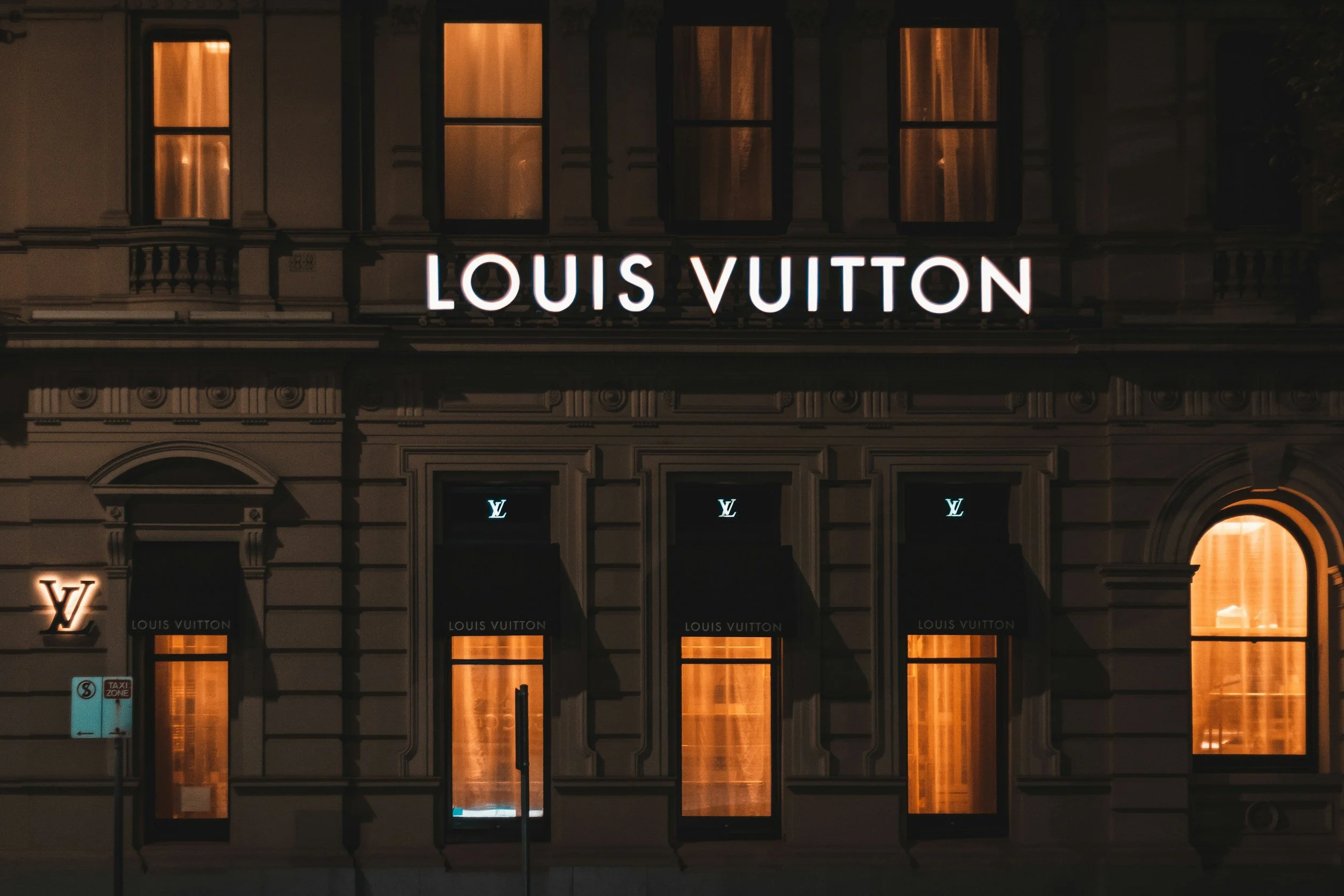
In the world of fashion, inspiration is inevitable. Every collection also stems from the ability to reinterpret existing elements: historical references, artistic movements, decorative motifs, and aesthetic languages that span eras and cultures. Creativity, after all, never develops in complete isolation from what came before it. But when this reinterpretation ceases to be an exercise in inspiration and becomes a violation of the Copyright?
It is a question that has always been part of the fashion industry and has returned to the spotlight with the lawsuit filed in 2022 by American designer Paula Hian against Louis Vuitton and Off-White, which she accuses of reproducing some of her designs without authorization.
The case specifically concerns a decorative motif called “Plaque D’egout,” characterized by a black-and-white checkerboard pattern with irregular and distorted lines. According to the designer, certain products of the defendants incorporate substantial elements of her creation, thereby constituting an infringement of the copyright.
In June 2024, the U.S. District Court for the Eastern District of Pennsylvania reviewed Paula Hian’s motions, denying several of them but allowing the case to proceed with respect to certain designs alleged to reproduce the “Plaque D’egout” motif. The judge found that, at least at that initial stage of the proceedings, the allegations regarding the defendants’ possible access to the work and the similarity between some of the disputed designs were sufficient to warrant further examination.
This step, of course, does not amount to a finding of infringement. Determining that a claim warrants review is different from acknowledging that the Copyright has in fact been infringed.
The dispute took on particular significance in July 2026, when Louis Vuitton and Off-White filed a motion for summary judgment, asking the court to rule in their favor without the need for a full trial. The defense argues that there is insufficient evidence of copying and, above all, that the disputed designs are the result of an independent creative process.
To prove this, the companies cite a collection of materials developed during the design process for Virgil Abloh’s Spring/Summer 2021 collection: sketches, mood boards, stylistic research, and internal communications that allegedly document the evolution of the ideas behind the products.
According to the defense’s account, the design was also inspired by the aesthetics of ska music and earlier visual references, reinterpreting a graphic language that was already widely used. After all, the checkerboard pattern is a recurring element in the history of design and fashion, and it is also part of Louis Vuitton’s own tradition, as the company introduced the famous Damier pattern in 1888.
This is precisely where the controversy becomes particularly interesting. The issue is not whether two works may resemble one another, but whether that resemblance stems from the reproduction of protected original elements or from the independent use of a shared aesthetic heritage.
The Copyright, in fact, does not grant anyone a monopoly on a style, an idea, or a decorative motif considered in the abstract. Instead, it can protect the specific creative expression that arises from the selection and combination of those elements, provided the requirements set forth by law are met.
Under U.S. law, a violation of the “ copyright ” requires establishing that there has been an unauthorized copy of the protected elements of the work. Similarity can certainly serve as an indication, especially when accompanied by evidence that the alleged infringer had access to the prior work. But it is not necessarily decisive. Two authors may independently arrive at similar results, without this constituting a violation of the Copyright.
Demonstrating the independence of the creative process, however, is not always easy. Years later, it can be difficult to reconstruct how an idea came about, what sources were used, and what steps led to the final product.
It is in this context that sketches, mood boards, and design documents take on an importance that goes far beyond their original function. Materials normally used to coordinate the work of designers can become evidence capable of reconstructing the genesis of a collection and demonstrating that a particular result was achieved independently.
Of course, the mere existence of a creative archive does not, by itself, guarantee a favorable outcome in a dispute. The documentation must be authentic, consistent, and sufficiently detailed to demonstrate an actual development process. Its value will also depend on the other available evidence and the specific circumstances of the case.
This issue is not foreign to European law. Even in the European Union, according to the principles established by the Court of Justice, protection Copyright requires that the work constitute an original intellectual creation, an expression of its author’s free and creative choices. Protection does not extend to abstract ideas, but rather to the form in which these ideas find a specific creative expression.
In the fashion industry, where trends, influences, and aesthetic languages are constantly shared and reinterpreted, the line can be particularly difficult to draw. The presence of common elements does not necessarily preclude the originality of a creation, just as a simple modification of an existing design is not always sufficient to rule out infringement.
The dispute between Paula Hian and Louis Vuitton thus raises issues that concern not only the protection of creative works but also the organization of work within creative companies.
Traditionally, brands focus on protecting the final product through trademarks, designs, Copyright and confidentiality agreements. Less attention is sometimes paid to preserving the documentation that accompanies the development of a collection.
Yet this very documentation can prove crucial when a company is called upon to defend itself against a plagiarism accusation. Preserving the various versions of a project, identifying sources of inspiration, and keeping track of creative decisions means not only preserving the company’s history but also being able to trace the origin of a particular design when necessary.
The Louis Vuitton case illustrates that the protection of creativity should not be viewed solely from the perspective of those who seek to prevent the copying of their works, but also from the perspective of those who must be able to prove that they created their works independently.
Double-click to edit...