
In the world of licensing, obtaining the rights to a character or a television show may seem sufficient to create products featuring that character or show.
But what happens when those products also reproduce a work created by someone who was not a party to the agreement?
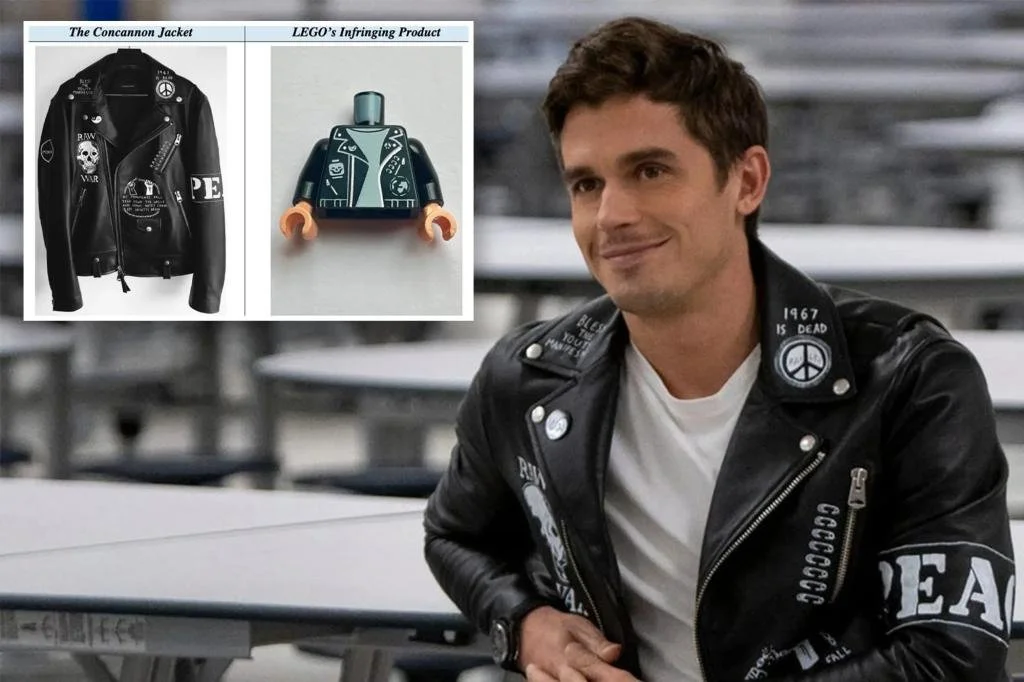
This is the issue at the heart of a U.S. legal dispute between LEGO and James Concannon, an artist who had customized a jacket worn by Antoni Porowski, one of the stars of the Netflix series *Queer Eye*. A seemingly minor incident, it nevertheless offers an important lesson on how intellectual property rights are acquired and exploited. In 2018, Concannon created a black leather jacket for Porowski, decorated with original lettering, symbols, and images.
The garment appears in several episodes of *Queer Eye*. Subsequently, as part of a licensing agreement related to the show, LEGO released a set dedicated to its stars. The minifigure depicting Porowski wears a jacket that incorporates several elements of Concannon’s design. The artist objects to the unauthorized use of his works and files a lawsuit for violation of the copyright, along with additional claims regarding trade dress protection and Connecticut’s unfair trade practices laws.
On September 27, 2026, the U.S. District Court for the District of Connecticut ruled on LEGO’s motion for summary judgment. The decision is significant: the claims based on the “ copyright ” may proceed, while the claim regarding trade dress wasdismissed. This is not, therefore, a final ruling of infringement of the Copyright, but rather a ruling that clarifies certain limits of the defenses raised by LEGO.
Consent to appear is not an unlimited license. One of LEGO’s defense arguments was that Concannon, having made the jacket for Porowski and knowing it might be worn during filming, had implicitly authorized the use of the work.
According to this interpretation, the authorization would also have permitted the subsequent reproduction of the jacket as part of the program’s merchandise. The fact that a work may appear on television does not necessarily constitute consent to its industrial reproduction and commercialization as a standalone product.
In order for an implied license to be recognized, it is necessary to verify the actual intent of the parties and the scope of the authorized uses. It is one thing to allow a television personality to wear a jacket during filming. It is quite another to authorize a toy manufacturer to reproduce its decorative features on thousands of products intended for sale.
The first circumstance does not automatically imply the second.
LEGO had also invoked the U.S. doctrine of fair use, arguing, among other things, that the reproduction of the miniature jacket constituted a transformative use necessary for the portrayal of the character. This argument, too, was rejected during the proceedings in question.
The Court examined the four factors set forth in U.S. law, placing particular emphasis on the commercial purpose of the use and the absence of a purpose sufficiently distinct from that of the original work.
The transition from an actual jacket to a graphic element on a minifigure does not, in and of itself, constitute transformative use. The reduction in size, the change in medium, and the incorporation into a different product are not sufficient to negate the relevance of the “ copyright.” The point is not merely how much a work has been modified, but why it is reproduced and what function it serves in its new context.
This case highlights a recurring issue in the audiovisual industry and in merchandising: the fragmentation of rights.
A television program may include musical works, costumes, photographs, graphics, set designs, design objects, and other creative contributions created by different parties. The producer may have the necessary authorizations to incorporate these elements into the audiovisual work without also having acquired the rights to exploit them independently.
The same applies to anyone who subsequently purchases a license for the program. The contract with the format owner does not necessarily guarantee the availability of all rights to the incorporated works.
In the Italian legal system, this issue is also addressed in Article 119 of the Law on Copyright, which, in the context of a publishing contract, establishes a principle of strict interpretation regarding the scope of the rights granted. More generally, the content and scope of each assignment or license must be assessed in light of the relevant contractual provision. It is therefore not enough to know who grants a license; it is necessary to determine which rights they are actually authorized to grant.
For audiovisual producers, agencies, brands, and companies that develop derivative products, the risk is not limited to legal disputes. Incomplete authorization can jeopardize the launch of a product line, prevent access to certain markets, or require the renegotiation of rights once the product has already been produced.
That is why a review of the chain of title should include not only the primary rights to the content, but also those relating to creative elements that could become independently significant in subsequent forms of exploitation.
The LEGO case serves as a reminder that a license can be perfectly valid and, at the same time, not broad enough to carry out the commercial project for which it was acquired.
In intellectual property, the value of what you purchase depends primarily on how accurately the rights you can actually use have been identified.
Double-click to edit...